Jainam Vora | Aug 10, 2026 | 10 Minutes Read
Understanding CKYC 2.0: The Evolution of India's Financial Identity Infrastructure
Every financial relationship begins with trust. Before a bank opens an account, an NBFC disburses a loan, an insurer issues a policy, or a broker enables an investment, one fundamental question must be answered:
Answering this question goes far beyond collecting a PAN card or address proof. Identity verification sits at the intersection of regulation, technology, fraud prevention, operational efficiency, and customer experience.
As India's financial ecosystem becomes increasingly digital, the infrastructure supporting customer identity is evolving as well. One of the most important components of this ecosystem is the Central KYC Records Registry (CKYCRR), commonly known as CKYC.
While CKYC has existed for several years, discussions around CKYC 2.0 represent an important evolution in how financial institutions manage, access, and reuse customer identity information.
The terms KYC, CKYC, and CKYCRR are often used interchangeably, but they serve different purposes.
What is KYC?
Know Your Customer (KYC) is the regulatory process through which a financial institution establishes and verifies the identity of its customer.
KYC supports several objectives, including:
- Establishing that the customer is who they claim to be
- Preventing identity fraud and impersonation
- wSupporting Anti-Money Laundering (AML) and Counter-Terrorist Financing (CFT) requirements
- Understanding the nature of the customer relationship
- Supporting ongoing customer due diligence
Importantly, KYC is not a one-time document collection exercise. It is an ongoing regulatory responsibility that can include periodic updates, transaction monitoring, and maintaining appropriate customer records.
If KYC is the process, CKYC is the framework that enables standardised and reusable KYC records across participating financial institutions.
Before CKYC, banks, NBFCs, insurers, mutual funds, brokers, and other financial institutions maintained their own independent KYC records. A customer could therefore be asked to submit similar documents repeatedly when interacting with different institutions.
CKYC was introduced to reduce this fragmentation by creating a standardised central repository of KYC records that authorised reporting entities can access in accordance with applicable regulations.
The Central KYC Records Registry (CKYCRR) is the central platform that supports this ecosystem. It is operated by CERSAI and enables authorised entities to upload, search, retrieve, and update KYC records through prescribed processes.
In simple terms:
- KYC = Regulatory process
- CKYC = Framework for reusable KYC records
- CKYCRR = Central registry supporting the framework
The core problem CKYC addresses is fragmentation.
Imagine a customer who opens a savings account with a bank, then applies for a personal loan, purchases insurance, opens a demat account, and invests in mutual funds.
Each institution may independently request information such as:
- PAN
- Proof of Identity (PoI)
- Proof of Address (PoA)
- Photograph
- Signature
- Date of Birth
- Customer declaration
- Additional KYC information required under applicable regulations
From the customer's perspective, this creates repetitive onboarding experiences. From an institution's perspective, it creates additional document collection, verification, storage, reconciliation, and operational costs.
The problem was not that individual institutions were performing KYC incorrectly. The problem was that customer identity information remained fragmented across independent systems.
CKYC introduced a common reference point for customer identity information.
The objective was to:
- Reduce duplication in identity verification
- Improve consistency of customer information
- Simplify customer onboarding
- Improve operational efficiency
- Support a more standardised financial identity ecosystem
However, CKYC was never designed to replace every other part of financial onboarding.
It does not approve loans, determine creditworthiness, replace AML processes, eliminate fraud controls, or remove an institution's responsibility for KYC and Customer Due Diligence.
It standardises identity infrastructure; regulatory responsibility remains with the individual institution.
CKYC 2.0 should not be viewed as an entirely new KYC framework.
It does not replace existing Customer Due Diligence requirements or change the responsibility of banks, NBFCs, insurers, and other regulated entities.
Instead, it represents the next phase in the evolution of CKYCRR, focusing on how customer identity information is accessed, managed, integrated, and reused within the existing regulatory framework.
The need for this evolution comes from the changing nature of financial services.
Today's institutions increasingly operate through:
- Digital-first onboarding
- API-driven platforms
- Real-time decision-making
- Automated workflows
- Consent-based data access
- Increasingly sophisticated digital transactions
As financial services have become more digital, the underlying identity infrastructure also needs to become more interoperable and technology-friendly.
Several broad areas are central to the evolution.
1. API-Driven Interactions
Modern financial platforms increasingly rely on APIs instead of manual or portal-driven processes.
CKYC's evolution supports more structured interactions between regulated entities and the central registry, allowing identity verification to become a more integrated part of automated onboarding workflows.
2. Better Standardisation
As more institutions participate in the ecosystem, standardised information becomes increasingly important.
Consistent data structures can improve interoperability, reduce differences between systems, and make identity information easier to consume across different financial platforms.
3. Greater Emphasis on Consent
Customer identity information is highly sensitive.
The evolving CKYC ecosystem places greater emphasis on customer-authorised access, including consent mechanisms such as OTP-based consent for individual record retrieval.
This reflects the broader movement toward transparent, purpose-based access to customer information.
4. Improved Data Quality
A central identity system is only valuable when the information it contains is accurate and usable.
Efforts to improve record quality, reduce duplicate records, and make customer information more reliable can reduce operational effort and improve confidence during onboarding.
5. Modern Technology Infrastructure
As financial institutions adopt API-first, cloud-native, and event-driven architectures, identity infrastructure also needs to support these environments.
CKYC therefore becomes less of an isolated compliance interface and more of a component within a broader digital onboarding architecture.
One of the most important things to understand about CKYC 2.0 is what doesn't change.
Every regulated entity continues to be responsible for:
- Customer Due Diligence
- KYC compliance
- AML and CFT controls
- Sanctions screening
- Customer risk classification
- Ongoing monitoring
- Record maintenance
CKYC provides the identity foundation. It does not make regulatory decisions on behalf of the institution.
This distinction is especially important in lending.
CKYC can help establish who the customer is, but it does not determine:
- Whether the customer can repay
- Creditworthiness
- Existing indebtedness
- Income
- Bureau history
- Fraud risk
- Underwriting eligibility
Those decisions continue to depend on credit bureaus, income verification, fraud systems, underwriting models, and institutional policies.
For a customer, KYC may appear as a few screens on a mobile application.
Behind those screens, however, a modern onboarding journey can involve multiple systems:
- Customer-facing application
- API gateway
- Identity services
- CKYCRR
- PAN verification
- Aadhaar-based verification where applicable
- DigiLocker where applicable
- AML and sanctions screening
- Fraud and risk engines
- Credit bureau integrations
- Consent management
- Customer master systems
- Audit and compliance systems
This is why CKYC should not be treated simply as another API integration.
The more important question is:
How should the onboarding platform respond to the information received from CKYC?
For example:
- Should onboarding continue automatically?
- Is customer consent required?
- Does additional verification need to be performed?
- Does the customer need to update information?
- Should the application move to manual review?
These are orchestration decisions, not CKYC decisions.
A mature onboarding platform therefore needs to support multiple outcomes, including a matching record, multiple matches, no record, pending consent, failed consent, information requiring updates, additional verification, or technical retries.
As identity infrastructure becomes increasingly digital, consent should be treated as more than just a checkbox or screen.
A robust onboarding platform should be able to capture:
- Who requested the information
- Why the information was requested/li>
- When consent was provided
- How consent was authenticated
- The outcome of the consent process
- Transaction references
- The associated audit trail
Auditability is equally important.
Financial institutions should be able to understand what identity information was retrieved, which verification steps were performed, what decisions were made, when they occurred, and which workflow or policy was applied.
Automation improves efficiency. Auditability builds trust. Both need to evolve together.
CKYC and KYC are the same
They are not.
KYC is the regulatory process, while CKYC provides infrastructure for managing and reusing KYC records.
A CKYC number means KYC is permanently complete
Not necessarily. Customer information can change, risk profiles can evolve, and periodic KYC updates may still be required.
CKYC 2.0 eliminates all repeated KYC
Its objective is better reuse of identity information and reduction of unnecessary duplication, not elimination of every verification requirement.
CKYC replaces Aadhaar or Video KYC
It does not. These systems and processes serve different purposes and may complement each other depending on the applicable regulatory framework.
CKYC is a loan approval system
It is not. CKYC establishes customer identity; lending decisions require independent credit, risk, fraud, and underwriting assessments.
CKYC replaces an institution's customer database
It does not. Financial institutions still require their own customer systems for servicing, transactions, risk management, reporting, collections, and other business functions.
CKYC becomes even more useful when viewed as one component of a much larger ecosystem.
A digital financial journey may combine:
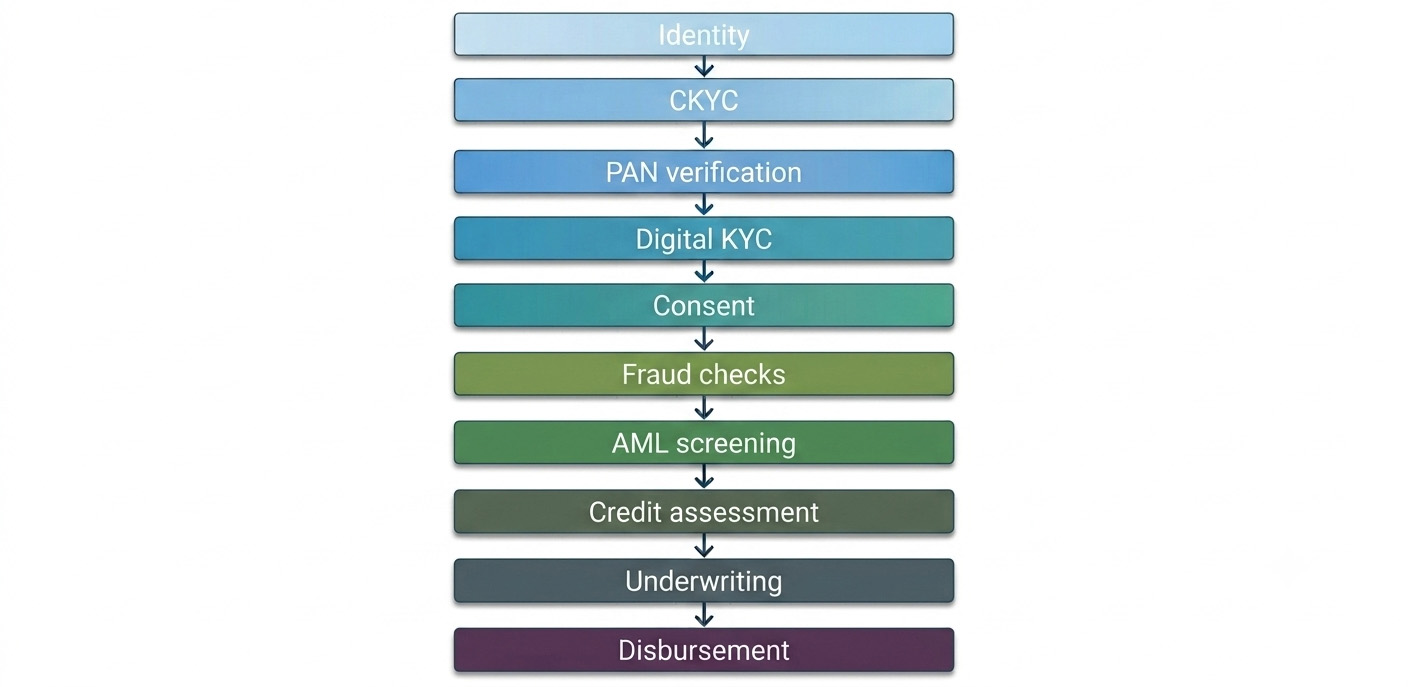
Each capability answers a different question.
Identity establishes who the customer is.
Risk assessment determines whether the institution wants to establish the relationship.
Credit assessment determines whether the customer qualifies for a product.
Fraud systems assess whether the interaction appears genuine.
AML controls determine whether additional regulatory attention is required.
CKYC contributes primarily to the identity layer while working alongside these other specialised capabilities.
This is why interoperability is often more important than centralisation.
Shared infrastructure does not mean shared underwriting. Shared identity does not mean shared risk. Shared standards do not mean identical customer journeys.
Each institution can continue to differentiate itself through its products, risk policies, services, and customer experience while relying on a common identity foundation.
For Business Leaders
Customer onboarding is increasingly a competitive differentiator. Faster, simpler, and more reliable onboarding can directly influence customer acquisition and operational efficiency.
For Product Managers
Every additional onboarding step creates customer effort. Reusable identity information can help reduce unnecessary friction while maintaining regulatory compliance.
For Technology Teams
CKYC should be considered part of a broader onboarding architecture involving identity, consent, verification, compliance, and workflow orchestration. Flexible and loosely coupled systems are better positioned to adapt as requirements evolve.
For Compliance Teams
Standardised identity infrastructure can improve consistency and operational efficiency while regulated entities continue to retain responsibility for CDD, AML, sanctions screening, and ongoing compliance.
The evolution of CKYC reflects a broader shift in India's financial ecosystem: shared infrastructure with clearly defined responsibilities.
Identity, documents, consent, payments, and financial data can increasingly be supported by common infrastructure, while individual institutions continue to make their own business, risk, and compliance decisions.
The objective of CKYC has not fundamentally changed. It remains focused on enabling authorised financial institutions to maintain and reuse standardised customer identity information within the applicable regulatory framework.
What is changing is how efficiently and seamlessly that infrastructure can interact with modern digital financial platforms.
For customers, the ideal outcome is simple: fewer unnecessary repetitions, clearer consent, and more consistent onboarding experiences.
For institutions, it means better standardisation, interoperability, automation, and data quality.
For technology teams, it means building reusable identity services, configurable workflows, stronger governance, and better auditability.
CKYC should not be viewed as a replacement for KYC, a substitute for regulatory compliance, or a credit decisioning platform.
It is better understood as shared financial identity infrastructure that helps regulated institutions manage and reuse customer identity information more efficiently.
As digital financial services continue to evolve, onboarding will increasingly depend on how effectively identity, consent, compliance, fraud prevention, interoperability, and customer experience work together.
The future of digital onboarding will not be defined by a single technology or platform. It will be shaped by well-designed ecosystems where trusted identity infrastructure and institution-specific decision-making work together seamlessly.
Understanding CKYC 2.0 is therefore not just about understanding another regulatory technology. It is about understanding how India's financial identity infrastructure is evolving to support the next generation of digital financial services.