Jainam Vora | Mar 15, 2026 | 10 Minutes Read
When Financial Systems Run Themselves
For most of modern financial history, systems have been designed to process transactions, not make decisions.
Banks process payments. Lenders process applications. Finance teams process reports.
Even today, despite the explosion of fintech innovation, much of financial infrastructure still operates on human-driven workflows layered on top of digital systems.
But that paradigm is beginning to shift.
A new generation of infrastructure is emerging — Autonomous Finance — where financial systems are designed not just to execute instructions, but to observe financial activity, make decisions, and act independently in real time.
For CXOs and financial infrastructure builders, this shift represents one of the most significant architectural transformations in finance since the rise of digital payments.
Most financial institutions and enterprises operate on decision latency.
Data flows through systems continuously, but decisions happen periodically.
Credit committees review applications. Treasury teams rebalance liquidity. Fraud analysts investigate suspicious transactions. Compliance teams review activities after the fact.
This model worked when financial systems were slower and transaction volumes were manageable.
But modern financial ecosystems are:
- real-time
- API-driven
- Globally interconnected
- Increasingly algorithmic
As transaction velocity increases, human decision loops become bottlenecks.
The future of finance will therefore depend on decision automation at infrastructure level.
The fintech revolution digitized financial services.
Autonomous finance goes a step further — it removes the need for manual decision orchestration.
In an autonomous financial architecture:
- Credit lines adjust automatically as financial signals change
- Fraud systems intervene before transactions settle
- Treasury reallocates liquidity dynamically across accounts
- Compliance rules are embedded directly into transaction flows
- Financial risk is evaluated continuously rather than periodically
In other words, financial systems evolve from transaction processors to decision-making systems.
This transition mirrors what we saw in other industries.
Cloud infrastructure automated server management. Autonomous supply chains optimize inventory dynamically. Algorithmic trading transformed capital markets.
Finance is now moving toward self-operating infrastructure.
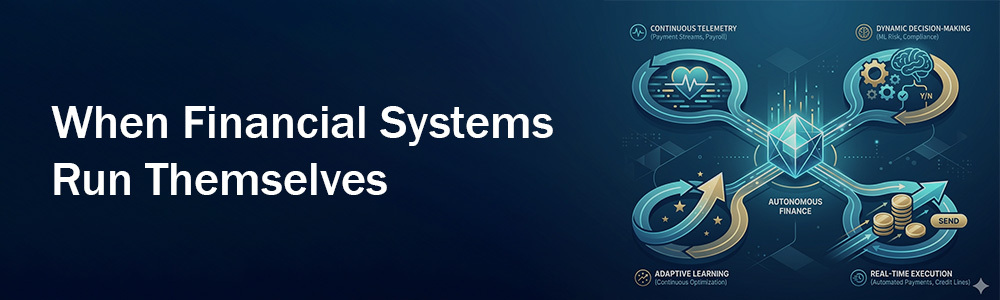
Autonomous finance infrastructure typically emerges across three layers.
1. Continuous Financial Telemetry
Autonomous systems require real-time financial visibility.
Traditional finance relies on static snapshots:
- monthly statements
- quarterly financials
- periodic risk reviews
Autonomous systems rely instead on continuous financial signals, including:
- payment streams
- payroll flows
- merchant activity
- behavioral transaction patterns
- external economic signals
Financial infrastructure begins to resemble observability systems used in cloud computing — constantly monitoring system health and responding instantly to anomalies.
2. Autonomous Decision Engines
Once real-time financial telemetry exists, the next layer is decision intelligence.
These engines continuously evaluate:
- creditworthiness
- fraud probability
- liquidity risk
- transaction anomalies
- regulatory compliance
Instead of static rule engines, modern systems use:
- machine learning models
- probabilistic risk scoring
- behavioral analytics
- predictive financial modeling
The result is continuous financial decision-making, rather than one-time approvals.
Credit, for example, evolves from a point-in-time decision to a dynamic financial relationship.
3. Automated Financial Execution
The final step is execution.
Autonomous systems must be able to act instantly when conditions are met.
Examples include:
- salary-triggered credit access
- automated loan repayments aligned with cash flow
- dynamic treasury rebalancing across accounts
- fraud blocking before settlement
- real-time compliance enforcement
This creates closed-loop financial systems, where sensing, decision-making, and execution operate as a single continuous cycle.
Why This Shift Is Happening Now
Autonomous finance is becoming feasible due to several technological shifts.
API-Driven Financial Infrastructure
Financial services are becoming programmable.
Payments, lending, identity verification, and compliance can now be triggered via APIs.
This programmability enables automation at infrastructure level.
Real-Time Payment Networks
Settlement cycles are shrinking from days to seconds.
Real-time rails enable systems to respond instantly to financial events.
Without instant settlement, autonomous systems cannot act effectively.
AI-Native Risk Modeling
Traditional risk models rely on limited variables and static credit reports.
Modern AI systems can evaluate thousands of behavioral and transactional signals in real time.
This allows risk assessment to move from static evaluation to dynamic monitoring.
Event-Driven Architecture
Modern fintech infrastructure increasingly relies on event-driven systems.
Instead of batch processing, systems react instantly to events such as:
- salary credited
- invoice paid
- payment anomaly detected
This event-driven architecture is the backbone of autonomous finance.
Strategic Implications for CXOs
For financial institutions, fintech builders, and large enterprises, autonomous finance will reshape how financial systems are designed.
Finance Becomes an Autonomous Layer
Finance functions may increasingly operate like self-optimizing infrastructure rather than manual operational units.
Treasury, credit, risk, and compliance become algorithmically managed systems.
Competitive Advantage Moves to Infrastructure
The next wave of fintech winners will not simply offer better user interfaces.
They will build financial operating systems capable of autonomous decision-making.
Infrastructure intelligence will become the new moat.
Financial Products Become Adaptive
Products will no longer be static offerings.
Instead they will adapt dynamically to user behavior and financial context.
Credit, liquidity, and payments will become context-aware services.
Managing the Risks of Autonomous Finance
While the potential benefits are significant, autonomous finance also introduces systemic risks.
Algorithmic Risk Amplification
Automated systems operating at scale can propagate errors rapidly if poorly designed.
Robust model governance will be essential.
Regulatory Transparency
Regulators will demand explainability in autonomous financial decision systems.
Financial institutions must design auditable AI architectures.
Security and Infrastructure Resilience
Autonomous systems increase the importance of infrastructure security.
Self-operating financial networks must be resilient, monitored, and fail-safe.
The Long-Term Vision
The long-term trajectory is clear.
Financial systems will evolve toward self-driving infrastructure.
Organizations will operate financial environments where:
- liquidity optimizes itself
- credit adjusts continuously
- compliance enforces itself
- fraud systems intervene automatically
- capital allocation adapts to real-time conditions
Finance will move from a managed process to an intelligent system layer embedded into digital infrastructure.
The Strategic Question for Leaders
For CXOs leading financial institutions and fintech platforms, the most important question is no longer:
How do we digitize financial services?
That transformation is already underway.
The real question is:
How do we design financial systems that can operate autonomously, safely, and at scale?
Because in the next decade, the most powerful financial platforms will not simply move money faster.
They will build systems where money manages itself.
Curious how autonomous finance will reshape lending, treasury, and payments over the next decade?
Would love to hear how others in fintech are thinking about this.