Jainam Vora | Mar 23, 2026 | 5 Minutes Read
The Future of Banking Is Identity, Not Accounts
For more than a century, the banking system has been designed around accounts. Every financial interaction — deposits, payments, credit, investments — begins with an account number.
But a quiet shift is underway.
In the next decade, identity will become the core infrastructure of banking, and accounts will become secondary containers.
The institutions that recognize this shift early will design the next generation of financial infrastructure.
Traditional banking architecture assumes that value lives inside accounts.
To transact, you need:
- An account number
- A bank identifier
- A payment rail linking two accounts
Whether it's wire transfers, ACH, RTGS, or card networks — the model is always the same:
Account → Payment Rail → Account
This model worked in a world where:
- Financial institutions were centralized
- Identity verification was manual
- Financial relationships were long-term and location-bound
But the digital economy operates very differently.
People now interact with dozens of financial services simultaneously — payments, lending, insurance, investments, wallets, BNPL platforms, digital assets.
The account-based model is starting to show its limits.
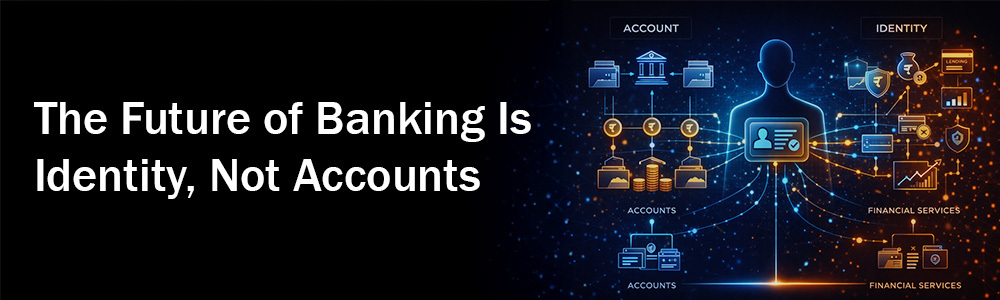
A new model is emerging where identity becomes the anchor for financial services.
Instead of asking:
"Which account should this transaction come from?"
Financial systems will increasingly ask:
"Is this verified identity authorized to perform this transaction?"
Once identity is verified, financial services can dynamically assemble around the user.
This model enables:
- Account abstraction
- Cross-platform financial access
- Seamless portability of financial relationships
- Embedded finance across ecosystems
In identity-first banking, the user becomes the platform.
Digital identity frameworks are evolving rapidly.
Governments and technology platforms are building identity layers that sit beneath financial services.
Examples include:
- National digital ID systems
- Decentralized identity frameworks
- Biometric authentication layers
- Verifiable credentials
For financial institutions, this creates an opportunity to redesign onboarding, compliance, and risk management.
Instead of repeatedly verifying identity across products, institutions will rely on trusted identity credentials that can be reused across the ecosystem.
This dramatically reduces:
- onboarding friction
- KYC costs
- fraud exposure
- compliance complexity
Perhaps the biggest transformation will occur in credit infrastructure.
Today, credit is tied to institutions and accounts.
If a customer changes platforms, much of their financial history becomes fragmented.
Identity-centric finance changes this dynamic.
Creditworthiness will increasingly be linked to portable identity-based financial profiles rather than specific bank accounts.
This allows:
- instant lending decisions
- ecosystem-wide credit portability
- real-time underwriting based on verified financial activity
In effect, your identity becomes your financial passport.
Accounts will not disappear. But they will become invisible infrastructure behind identity layers.
Just as cloud computing abstracted physical servers, identity-centric architecture will abstract financial accounts.
Users will interact with financial services through:
- digital identities
- verified credentials
- permissioned data access
Behind the scenes, accounts may still exist — but the customer experience will be identity-driven.
This shift has profound implications.
Institutions that continue to think in terms of products and accounts will struggle.
The winners will build systems around:
- identity orchestration
- data portability
- real-time trust frameworks
- programmable permissions
In this model, the financial institution becomes less of a balance-sheet container and more of a trust infrastructure provider.
The real question is no longer:
"How do we acquire more accounts?"
The real question is:
"How do we become a trusted identity node in the financial ecosystem?"
Because in the next generation of banking, the most valuable asset will not be deposits.
It will be trusted identity relationships.
And the institutions that control identity infrastructure will control the future of finance.