Jainam Vora | Mar 22, 2026 | 5 Minutes Read
Programmable Money Will Rewrite Financial Infrastructure
Financial infrastructure has evolved in layers.
From physical cash… to digital banking… to real-time payments.
But the next shift is far more fundamental.
Money itself is becoming programmable.
And when money becomes programmable, financial systems stop being passive ledgers and start becoming autonomous infrastructure.
For centuries, money has functioned as a static store and transfer of value.
Even in the digital era:
- Payments are executed
- Rules are enforced outside the money
- Compliance is applied after transactions happen
Banks, ERPs, auditors, and regulators all operate around money, not inside it.
This architecture creates:
- settlement delays
- reconciliation costs
- compliance overhead
- fraud vulnerabilities
- operational friction
Financial infrastructure today is essentially a massive coordination layer trying to manage static money.
Programmable money changes that equation.
Programmable money embeds logic directly into the currency or payment instrument.
Money can now carry rules such as:
- When it can be used
- Where it can be spent
- Who can receive it
- How it can move
- What conditions trigger payment
Instead of processing payments and then verifying rules, the money enforces the rules itself.
Examples already emerging globally:
- Smart contract based payments
- Tokenized assets
- Central Bank Digital Currencies (CBDCs)
- Conditional government transfers
- Automated escrow and milestone payments
The implication is profound:
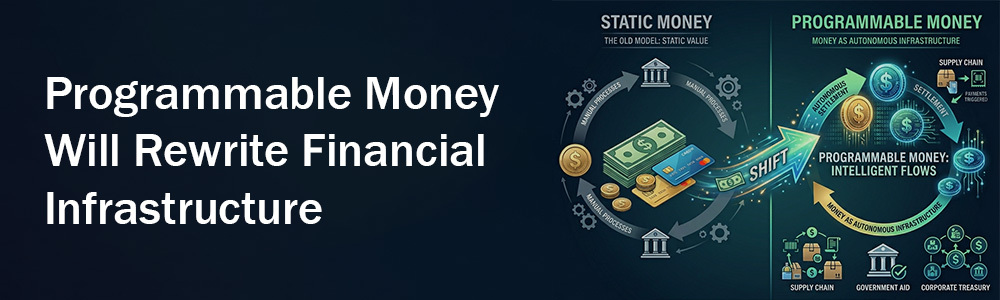
Financial infrastructure no longer processes money. It orchestrates programmable financial flows.
In a programmable money world, the architecture of finance changes from:
Today:
Bank → Payment rail → Settlement → Compliance → Reconciliation
Tomorrow:
Rule → Trigger → Autonomous Settlement
Consider a few real-world scenarios.
Supply Chains
Payments can be triggered automatically when:
- goods are scanned at a port
- IoT sensors confirm delivery
- smart contracts validate invoices
No manual approvals. No reconciliation cycles.
Just event-driven financial execution.
Subsidies, benefits, and grants can be issued as programmable funds that:
- can only be used for approved categories
- expire if unused
- automatically return if conditions fail
Leakage and misuse drop dramatically.
Treasury systems could deploy programmable capital that:
- releases funds based on project milestones
- enforces budget constraints automatically
- optimizes liquidity across accounts
Finance teams shift from approving transactions to designing financial logic.
Programmable money introduces an entirely new financial stack.
Traditional Stack:
- Core Banking
- Payment Rails
- Clearing & Settlement
- Reconciliation Systems
- Compliance Monitoring
Emerging Stack:
- Digital identity layers
- Tokenization platforms
- Smart contract engines
- Real-time data oracles
- Autonomous compliance protocols
The result is a financial system where execution, compliance, and settlement happen simultaneously.
This compresses financial workflows that once took days or weeks into seconds.
The question for leadership teams is no longer:
"Will programmable money arrive?"
It already is.
The real question is:
Will your financial architecture be compatible with it?>
Organizations that adapt early will unlock:
- frictionless financial operations
- lower operational costs
- real-time capital efficiency
- programmable financial products
- new revenue models
Those that don't risk running 20th-century infrastructure in a programmable economy.
The most transformative aspect of programmable money is not speed.
It is autonomy.
When money becomes programmable:
- contracts execute themselves
- compliance enforces itself
- payments trigger themselves
- settlements finalize instantly
Finance evolves from a process to a protocol.
And the institutions that understand this shift early will not just modernize their infrastructure.
They will help define the architecture of the next financial system.
The biggest financial innovation of the next decade may not be a new payment rail or banking product.
It may be something far simpler — yet far more powerful.
Money that knows what it is supposed to do.
And when that happens, financial infrastructure will never look the same again.